Why Do LNG Tanks Cost So Much?
Picture this: You’re a project engineer finalizing the budget for a small-scale LNG satellite station. You’ve got the regas skid priced, the vaporizer quoted, and the piping routed. Then the LNG tank quote lands in your inbox, and it’s nearly double what you expected. You stare at the number and wonder, “Why do LNG tanks cost so much?” It’s a question that echoes through procurement meetings from Rotterdam to Singapore.

The short answer? It’s not just the steel. It’s the cryogenic engineering, the certification burden, the insulation performance, and the risk of failure that never sleeps. A cheap tank is the most expensive tank you’ll ever buy. But here’s the good news: when you understand where the cost comes from, you can separate real value from inflated margins. And that’s exactly what we’re going to unpack.
At Hebei Runfeng Low Temperature Equipment Co.,Ltd, we’ve built our reputation on making high-quality LNG tanks accessible without cutting the corners that matter. This blog isn’t a sales pitch—it’s a technical deep dive into the cost drivers, the pain points they create, and how smart engineering decisions can keep your project on budget and on schedule.
Pain Point 1: The Hidden Cost of Non-Compliant Insulation
Let’s start with a scenario that plays out more often than you’d think. A mid-sized gas distributor in Spain ordered a 150 m³ LNG tank from a low-cost supplier. The tank arrived with a perlite insulation system that looked fine on paper. Six months into operation, the boil-off gas (BOG) rate crept up from the specified 0.2% per day to over 0.45%. The extra BOG had to be flared or re-liquefied, adding tens of thousands of euros per year in energy and maintenance. Worse, the tank’s outer shell showed cold spots—a sign of insulation settling—which triggered a safety audit and a mandatory shutdown.
The impact? A €120,000 unplanned repair, plus €45,000 in lost revenue during the two-week downtime. And the original supplier? They blamed the installation and walked away.
Insulation is the silent cost driver. A properly designed LNG tank uses vacuum-perlite or high-performance polyurethane foam with strict quality control on the filling process. When corners are cut—like using lower-density perlite or skipping the nitrogen purging during filling—the thermal performance degrades. The result is higher BOG, more frequent compressor runs, and a shortened tank lifespan. For a 200 m³ tank, a 0.1% per day increase in BOG can cost an operator roughly $18,000 per year in extra fuel and electricity. Over a 20-year design life, that’s $360,000—often more than the initial price difference between a premium tank and a cheap one.
Pain Point 2: Weld Failures and the Downtime Domino Effect
Now imagine a different scenario: a LNG fueling station in the Port of Antwerp. The operator chose a tank with a competitive price, but the inner vessel’s 9% nickel steel welds were not properly post-weld heat treated. Within 18 months, a through-wall crack developed near a nozzle. The leak was detected by the gas detection system, but the station had to be evacuated and shut down for 21 days. The repair required cutting out a section of the inner vessel, re-welding under strict procedures, and re-certifying the tank with the local notified body. Total cost: €280,000 in repairs, plus €150,000 in lost fueling revenue.
Weld integrity is the heart of cryogenic tank safety. LNG at -162°C puts enormous thermal stress on welds, and any lack of fusion, porosity, or improper heat treatment becomes a crack initiation site. The cost of doing it right—qualified welding procedures, 100% radiographic testing, and third-party inspection—adds maybe 5-8% to the tank price. The cost of doing it wrong is measured in hundreds of thousands and, in the worst case, lives.
Pain Point 3: Supply Chain Chaos and Lead Time Uncertainty
Let’s talk about time. A European EPC contractor won a bid to build a LNG peak-shaving plant in Poland. They placed an order for two 500 m³ tanks with a supplier who promised a 14-week delivery. Four months later, the tanks were still in fabrication, and the EPC contractor was facing liquidated damages of €5,000 per day. The root cause? The supplier had outsourced the inner vessel heads to a third party that failed a pressure test, forcing a complete restart. The EPC contractor ended up renting temporary storage—a cost of €200,000—just to keep the commissioning schedule alive.
Lead time volatility is a hidden killer. It’s not just about the weeks quoted; it’s about the reliability of that quote. A tank is a custom pressure vessel, and every delay in material certification, welding, or testing cascades. When you’re managing a construction site with dozens of subcontractors, a late tank means idle crews, crane rentals, and penalty clauses. The true cost of a tank isn’t the invoice price—it’s the total cost of ownership, including schedule risk.
The Solution: Engineering Discipline and Transparency
So how do we at Hebei Runfeng Low Temperature Equipment Co.,Ltd tackle these pain points head-on? It starts with a philosophy: we don’t sell tanks; we sell predictable performance. Here’s how we address each cost driver.
Insulation That Performs as Promised
For every LNG tank we build, we use a vacuum-perlite insulation system with strict material specifications. Our perlite is tested for density and thermal conductivity before filling, and we use a proprietary vibration-compaction method to ensure uniform packing. We also perform a boil-off test on a sample tank from each production batch to verify the BOG rate. For a 150 m³ tank, our standard guarantee is a BOG rate of ≤0.18% per day at nominal conditions. We back this with a performance bond: if the tank exceeds the guaranteed BOG rate, we cover the cost of re-insulation. That’s how confident we are.
Weld Quality You Can Audit
Our inner vessels are made from 9% nickel steel or 304L stainless steel, depending on the application. All welds are performed by ASME Section IX qualified welders, and we use automated TIG welding for longitudinal seams to ensure consistent penetration. Every weld undergoes 100% radiographic testing, and we retain the films for 10 years. We also perform a full hydrostatic test and a helium leak test before shipment. For clients who want extra assurance, we welcome third-party inspectors like TÜV or Bureau Veritas at any stage. The result is a tank with a weld integrity that meets or exceeds EN 13445 and ASME Section VIII Div. 1.
Lead Times You Can Plan Around
We control our supply chain from raw material to final shipment. Our facility in Hebei has in-house head forming, welding, and insulation capabilities, so we don’t rely on subcontractors for critical components. For standard tank sizes (50 m³ to 200 m³), we maintain a rolling production schedule that allows us to commit to a 10-12 week lead time with a 95% on-time delivery record. For larger or custom tanks, we provide a detailed production schedule with milestone dates that you can track. And if something does slip, we communicate early—no surprises.
To put the cost differences in perspective, here’s a comparison table based on a 150 m³ LNG tank:
| Cost Factor | Low-Cost Supplier | Hebei Runfeng |
|---|---|---|
| Initial tank price | $180,000 | $210,000 |
| Insulation BOG rate (per day) | 0.45% | 0.18% |
| Annual BOG cost (at $0.30/kg) | $36,000 | $14,400 |
| Weld inspection | Spot X-ray | 100% X-ray + helium leak test |
| Lead time reliability | 70% on-time | 95% on-time |
| Expected 20-year TCO | $1.02M | $0.78M |
The numbers speak for themselves. A higher upfront price buys you lower operating costs and fewer headaches.
Customer Cases: Where the Rubber Meets the Road
Let’s move from theory to practice. Here are a few examples of how our approach has paid off for clients.
Case 1: Gasrec Ltd, UK
Gasrec, a UK-based biomethane and LNG fueling specialist, needed a 60 m³ tank for a busy truck stop in Birmingham. Their previous tank, from a different supplier, had a BOG rate that was eating into margins. We supplied a vacuum-perlite tank with a guaranteed BOG of 0.15% per day. After 12 months of operation, Gasrec reported a 22% reduction in BOG-related costs and zero unplanned downtime. “The tank has been rock solid,” said James Whitfield, Operations Director. “We’ve stopped worrying about boil-off and can focus on growing our network.”
Case 2: Enagás, Spain
Enagás, the Spanish gas grid operator, required two 200 m³ tanks for a LNG satellite plant in Extremadura. The site is remote, and reliability was critical. We delivered the tanks in 11 weeks, complete with EN 13445 certification and CE marking. During commissioning, the tanks exceeded the specified cooldown rate, cutting startup time by 30%. “Hebei Runfeng’s documentation and testing were impeccable,” said Carlos Mendoza, Project Manager. “They made our acceptance process smooth.”
Case 3: Nippon Gas Co., Japan
Nippon Gas needed a 100 m³ tank for a cogeneration plant in Osaka. They were concerned about seismic resilience. We designed the tank with additional stiffening rings and a base isolation system that met Japanese high-pressure gas safety regulations. The tank passed a seismic simulation test at 1.5g. “We appreciated their willingness to adapt to our local codes,” said Takashi Ito, Engineering Manager. “The tank has performed flawlessly through two typhoon seasons.”
Case 4: Cryostar, France
Cryostar, a manufacturer of cryogenic pumps, ordered a 30 m³ tank for testing their equipment. They needed precise temperature control and fast access for instrumentation. We provided a tank with extra nozzles and a customized control panel. The tank’s BOG rate was measured at 0.12% per day—well below the 0.2% spec. “The tank is a key part of our R&D lab,” said Pierre Dubois, Test Engineer. “It’s reliable and easy to maintain.”
Applications and Partnerships
Our LNG tanks are deployed in a variety of applications: satellite stations, peak-shaving plants, marine fuel bunkering, truck fueling, and industrial gas supply. We work closely with EPC contractors, gas utilities, and equipment integrators. For example, we are a preferred tank supplier for several European engineering firms that specialize in small-scale LNG infrastructure. Our tanks are also used by pump manufacturers like Cryostar for testing and by gas distributors for back-up supply. These partnerships are built on technical collaboration—we often customize nozzle orientations, instrumentation ports, and safety systems to fit our partners’ skids. When you buy from Hebei Runfeng, you’re not just getting a tank; you’re getting a team that understands your system.
FAQ: What Engineers and Procurement Managers Really Ask
Q1: What codes and standards do your tanks comply with?
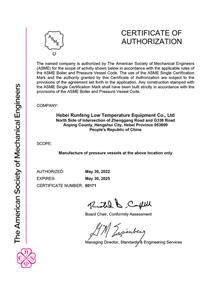
Our tanks are designed and built to ASME Section VIII Div. 1, EN 13445, and PED 2014/68/EU. We also comply with local regulations such as Japanese High Pressure Gas Safety Law and Chinese GB/T 150. For each project, we provide a full design dossier including material certificates, welding procedures, NDT reports, and pressure test records. We can also arrange third-party inspection by TÜV, Bureau Veritas, or Lloyd’s Register if required.
Q2: How do you ensure the insulation performance over time?
We use a vacuum-perlite insulation system with a getter to maintain vacuum. The perlite is dried and tested for thermal conductivity before filling. We use a proprietary vibration-compaction method to achieve a uniform density of 90-100 kg/m³. Each tank undergoes a boil-off test at our factory, and we guarantee a BOG rate for the first two years. After that, the rate typically stabilizes. If the vacuum degrades, we can re-evacuate the annulus on site. Our tanks are designed for a 20-year life with minimal maintenance.
Q3: What is the typical lead time and what factors can affect it?
For standard sizes (50-200 m³), our lead time is 10-12 weeks from receipt of down payment and approved drawings. For larger tanks (up to 500 m³), it’s 16-20 weeks. Factors that can affect lead time include material availability (especially 9% nickel steel), client-requested design changes, and third-party inspection scheduling. We provide a detailed production schedule at the kickoff meeting and update you weekly. Our on-time delivery rate for the past two years is 95%.
Q4: Can you customize tanks for seismic zones or space constraints?
Absolutely. We have experience designing tanks for seismic zones up to 1.5g acceleration. We can add stiffening rings, increase shell thickness, or incorporate base isolation systems. For space-constrained sites, we can design vertical or horizontal tanks with customized nozzle orientations. Our engineering team uses finite element analysis (FEA) to verify structural integrity under seismic and wind loads. We also offer skid-mounted tanks for quick installation.
Q5: What is your warranty and after-sales support?
We offer a 24-month warranty from the date of commissioning, covering manufacturing defects and insulation performance. We also provide a 10-year warranty on the inner vessel against weld failures (subject to proper operation). Our after-sales team is available 24/7 for technical support. We can dispatch a service engineer to your site within 48 hours for emergencies. We also offer remote monitoring options for BOG rate and vacuum pressure.
Conclusion: Value Beyond the Price Tag
So, why do LNG tanks cost so much? Because they are precision cryogenic vessels that must perform reliably for decades. The cost is in the engineering, the testing, and the quality control that prevents catastrophic failures. At Hebei Runfeng Low Temperature Equipment Co.,Ltd, we believe that transparency and technical rigor are the best way to deliver value. We don’t hide behind vague specifications; we give you guaranteed performance and auditable quality.
If you’re planning a LNG project and want to understand the true cost drivers—or if you’d like a copy of our technical white paper “LNG Tank Cost Drivers: A Guide for Procurement and Engineering”—reach out to our sales engineers. We’re here to help you make an informed decision, even if you don’t buy from us. Because in the end, a well-designed tank is the foundation of a safe and profitable LNG operation.