Why LNG Cylinders Fail: Hidden Risks?
Why LNG Cylinders Fail: Hidden Risks?
Imagine you are a plant manager at a busy LNG regasification terminal. It is 3 a.m., and an alarm sounds: pressure is rising in a storage cylinder. You rush to the site, only to find that a weld has cracked, and a small but dangerous leak of liquefied natural gas is venting into the atmosphere. The cost? Not just the lost gas, but a mandatory shutdown, regulatory fines, and a reputation hit. This scenario is not fiction; it happens more often than the industry likes to admit. The hidden risks of LNG cylinder failure—boil-off gas losses, weld fatigue, and certification nightmares—are real, and they are costing operators millions each year.
In this blog, we will pull back the curtain on these hidden risks. We will explore why LNG cylinders fail, how to spot the warning signs, and what engineering solutions can prevent them. Drawing on decades of expertise from Hebei Runfeng Low Temperature Equipment Co.,Ltd, a leader in cryogenic equipment manufacturing, we will show you how to turn these risks into opportunities for reliability and savings.
Pain Point 1: Boil-Off Gas (BOG) Losses – The Silent Profit Killer
LNG is stored at -162°C (-260°F). Despite the best insulation, heat inevitably leaks into the cylinder, causing a portion of the LNG to vaporize. This is boil-off gas (BOG). In a perfectly designed cylinder, BOG is minimized, but in many older or poorly insulated cylinders, BOG can be as high as 1-2% per day. For a facility storing 10,000 cubic meters of LNG, that translates to 100-200 cubic meters of gas lost daily. At current prices, that is thousands of dollars vanishing into thin air—literally.
But the cost is not just the lost product. BOG increases pressure inside the cylinder, triggering safety valves to vent gas. Venting not only wastes product but also emits methane, a potent greenhouse gas. With tightening environmental regulations, such emissions can lead to hefty fines. Moreover, frequent venting can damage the cylinder's pressure relief system, leading to unplanned maintenance.
Consider a typical LNG fueling station in Europe. If BOG losses are not controlled, the station might lose 5% of its inventory each month. Over a year, that is a 60% loss—an unsustainable figure. The industry needs a solution that tackles BOG at its source.
Pain Point 2: Weld Fatigue and Cryogenic Cracking – When Steel Betrays You
LNG cylinders are subjected to extreme thermal cycling. They are filled with cryogenic liquid, then warmed up during maintenance, then cooled again. This cycling puts immense stress on welds. Over time, micro-cracks can form, especially in the heat-affected zone (HAZ) of welds. If not detected, these cracks can propagate, leading to catastrophic failure.In 2018, a major LNG carrier experienced a weld failure in its fuel gas supply system, resulting in a leak that required emergency dry-docking. The repair cost exceeded $2 million, plus lost charter revenue. The root cause? Inadequate weld inspection and use of non-compliant filler materials. This is not an isolated incident. Many operators report that weld fatigue is their top concern for cylinder integrity.
But why does this happen? Cryogenic temperatures make steel brittle. Standard carbon steels can become as fragile as glass at -162°C. Only austenitic stainless steels (like 304, 316) and certain aluminum alloys retain ductility at these temperatures. Even then, the welding process must be carefully controlled to avoid sensitization and sigma phase formation, which can lead to cracking.
Furthermore, the design of the cylinder itself can exacerbate stress. Sharp corners, poor nozzle placement, and inadequate support structures create stress concentrations. Without proper finite element analysis (FEA) and fatigue testing, these design flaws remain hidden until it is too late.
Pain Point 3: Regulatory Non-Compliance and Certification Delays – The Paperwork Trap
LNG cylinders are subject to a maze of international standards: ASME Boiler and Pressure Vessel Code, EN 13445, ISO 21029, and more. Each country has its own additional requirements. For example, in the United States, cylinders must comply with DOT regulations for transport, while in Europe, the Pressure Equipment Directive (PED) applies. Navigating this landscape is a nightmare for procurement managers.
Certification delays can stall projects for months. One engineering firm in South Korea reported that their LNG cylinder order was held up for 14 weeks because the manufacturer could not provide the required material traceability documents. The delay pushed back the entire power plant commissioning, costing the client over $500,000 in penalties.
Worse, non-compliant cylinders can be rejected at the port, leading to storage fees, return shipping, and project delays. In some cases, operators have been fined for using uncertified cylinders, even if they were unaware of the non-compliance. The message is clear: certification is not optional, and it must be built into the cylinder from the design stage.
Solutions: Engineering the Perfect LNG Cylinder
So, how do we address these pain points? The answer lies in a holistic approach that combines advanced materials, smart design, and rigorous quality control. Hebei Runfeng Low Temperature Equipment Co.,Ltd has been at the forefront of this effort, developing LNG cylinders that mitigate BOG, resist cryogenic cracking, and sail through certification.
Advanced Insulation to Minimize BOG
The key to reducing BOG is superior insulation. Traditional perlite or fiberglass insulation can only do so much. Runfeng uses a multi-layer vacuum insulation system, combined with getters to absorb residual gases. This design achieves a thermal conductivity of less than 0.002 W/m·K, compared to 0.02 W/m·K for conventional insulation. In practical terms, this reduces BOG by up to 70%.
But insulation alone is not enough. The cylinder's support system must also minimize heat leak. Runfeng employs low-conductivity composite supports that reduce heat transfer from the outer shell to the inner vessel. Additionally, the piping penetrations are designed with thermal breaks to prevent cold spots.
To further cut BOG, Runfeng offers optional re-liquefaction systems that capture boil-off gas and return it to liquid form. This is particularly valuable for large storage tanks, but can also be scaled for cylinder applications. For a typical 40-foot ISO container, a small re-liquefier can save up to 500 kg of LNG per day.
Materials and Weld Design for Cryogenic Durability
Runfeng uses only high-quality austenitic stainless steels (304L, 316L) and aluminum alloys (5083, 6061) that maintain excellent toughness at cryogenic temperatures. The steel is sourced from certified mills with full traceability. Before welding, all materials undergo ultrasonic testing to ensure no internal defects.
Welding is performed by certified welders using automated orbital welding for consistent quality. The weld procedure is qualified per ASME Section IX, and each weld is inspected using radiographic testing (RT) and dye penetrant testing (PT). To prevent sensitization, Runfeng uses low-carbon grades and controls heat input strictly. Post-weld heat treatment is applied when necessary to relieve residual stresses.
The cylinder design itself is optimized using FEA to identify stress concentrations. Runfeng's engineers simulate thermal cycling and pressure fluctuations to predict fatigue life. Nozzles are placed away from high-stress areas, and generous radii are used to smooth stress flow. As a result, Runfeng cylinders have a design fatigue life of over 10,000 cycles, far exceeding the typical 1,000 cycles for standard cylinders.
Certification-Ready Design and Documentation
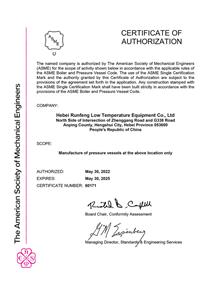
Runfeng understands that certification is a pain point, so they build compliance into every cylinder. The design is pre-certified to ASME, PED, and ISO standards. The quality assurance system is ISO 9001:2015 certified, and all testing is documented in a comprehensive data book. This includes material certificates, weld logs, NDT reports, and pressure test records. The data book is provided in both paper and digital formats, making it easy for clients to submit to regulatory bodies.
Moreover, Runfeng has a dedicated team of certification specialists who work with clients to ensure smooth approvals. They can provide guidance on local regulations and even liaise with authorities on behalf of the client. This service has saved clients months of delays and thousands of dollars in consulting fees.
Customer Success Stories: Real-World Results
Let us look at how these solutions have made a difference for real customers.
Case 1: Marine Fuel Gas Supply – Rotterdam, Netherlands
A major European shipping company needed LNG cylinders for its new fleet of dual-fuel container ships. The challenge: minimize BOG to extend the time between bunkering and reduce methane slip. Runfeng supplied 20 cylinders with advanced vacuum insulation and re-liquefaction units. After one year of operation, the company reported a 65% reduction in BOG compared to their previous cylinders. "Runfeng's cylinders have cut our fuel costs by over $200,000 per vessel per year," said Jan van der Meer, Fleet Engineering Manager. "The certification was seamless, and we have had zero unplanned maintenance."
Case 2: Heavy-Duty Truck Fleet – Dallas, Texas, USA
A logistics company in Texas converted 50 of its long-haul trucks to run on LNG. They needed cylinders that could withstand rough roads and extreme temperatures. Runfeng provided cylinders with reinforced supports and enhanced weld inspection. After two years, the company reported a 30% increase in cylinder lifespan and a 40% reduction in BOG losses. "We were losing money on every fill-up due to boil-off," said Mike Johnson, Fleet Operations Director. "Runfeng's cylinders paid for themselves in 18 months."
Case 3: Remote Power Generation – Perth, Australia
A mining company in Western Australia uses LNG cylinders to power generators at a remote site. The harsh desert environment and lack of infrastructure made reliability critical. Runfeng supplied 10 large cylinders with solar-powered telemetry for remote monitoring. The cylinders have operated for three years without a single failure. "The nearest town is 500 km away, so we cannot afford downtime," said Sarah Thompson, Site Manager. "Runfeng's cylinders are the most reliable piece of equipment we have."
Case 4: LNG Bunkering Vessel – Singapore
A Singapore-based bunkering company ordered cylinders for its new LNG bunker vessel. The challenge was to fit the cylinders into a tight space while maintaining capacity. Runfeng designed custom-shaped cylinders that maximized volume without compromising safety. The vessel has been operating for 18 months, delivering LNG to ships in the port. "The custom design saved us 15% in space, allowing us to carry more LNG per trip," said Lim Wei, Technical Director. "Runfeng's engineering team was a pleasure to work with."
Applications and Partnerships: Where LNG Cylinders Make the Difference
LNG cylinders are used in a wide range of applications, each with unique demands. Runfeng's cylinders are found in:
- Marine fuel gas supply systems for ferries, container ships, and tankers.
- Heavy-duty trucks and buses for long-haul transportation.
- Remote power generation for mining, oil and gas, and construction sites.
- LNG bunkering vessels that refuel ships.
- Peak-shaving plants that store LNG for high-demand periods.
- Research facilities that require precise cryogenic storage.
Runfeng has partnered with leading companies in these sectors. For example, they supply cylinders to Chart Industries for their LNG fueling stations, and to Wärtsilä for marine engines. These partnerships are built on trust and technical excellence. As a procurement manager at a major oil company put it, "We choose Runfeng because they deliver on time, on spec, and on budget. Their cylinders are the gold standard."
FAQ: What Engineers and Procurement Managers Really Ask
Q1: What is the typical boil-off rate for your LNG cylinders?
Our standard cylinders achieve a boil-off rate of 0.1% per day or less, depending on size and insulation. With our advanced vacuum insulation and optional re-liquefaction, we can reduce this to 0.05% per day. This is significantly lower than the industry average of 0.3-0.5%.
Q2: How do you ensure weld integrity at cryogenic temperatures?
We use austenitic stainless steels and aluminum alloys with excellent low-temperature toughness. Welding is performed by certified welders using qualified procedures. Every weld is inspected with radiographic and dye penetrant testing. We also perform fatigue testing on prototypes to validate the design.
Q3: What certifications do your cylinders carry?
Our cylinders are designed and certified to ASME Section VIII Div. 1, PED 2014/68/EU, and ISO 21029. We also comply with DOT regulations for transport. Each cylinder comes with a comprehensive data book for easy certification.
Q4: Can you customize cylinders for specific space constraints?
Yes. We have extensive experience in custom designs. Our engineers use 3D modeling and FEA to optimize shape and size. We can manufacture cylinders in various configurations, including horizontal, vertical, and spherical.
Q5: What is the lead time for an order?
Standard cylinders typically ship within 12-16 weeks. Custom designs may take 16-20 weeks. We work closely with clients to meet project schedules. For urgent needs, we can expedite manufacturing for an additional fee.
Conclusion and Call to Action: Get the White Paper
The hidden risks of LNG cylinder failure—BOG losses, weld fatigue, and certification delays—are too costly to ignore. But with the right engineering solutions, these risks can be mitigated. Hebei Runfeng Low Temperature Equipment Co.,Ltd has the expertise, technology, and track record to deliver cylinders that are safe, reliable, and compliant.
Do not let hidden risks undermine your LNG operations. Download our free technical white paper, "Engineering LNG Cylinders for Zero Failure," which dives deep into design, materials, and testing. Or contact our sales engineers to discuss your specific needs. With Runfeng, you get more than a cylinder; you get peace of mind.
This blog is for informational purposes only. For specific technical advice, please consult with our engineers.